

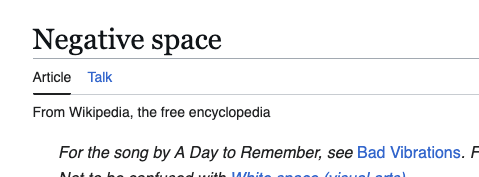

@noiob ah, trick question, because it's an ambiguous image, representing two different physically possible scenarios.
- if the yellow part is a vase, it's not empty. there's an object there, a vase
- if the black parts are faces, the yellow part is empty
In either case, the empty surfaces match the definition quoted on WP: "[...] negative space is the empty space around and between the subject(s) of an image."
There are two different ways to decompose this image but my initial concerns stand.
To resolve this conundrum, i conclude that "space" probably just isn't presumed empty in graphics design, unlike when talking about planets¹, rooms², shelves³, etc. Such differences in usage happen and they're fine, but this one got me a bit irritated.
¹: "Space" is the sum of mostly-empty places between celestial bodies
²: i have "no space in my room" when it's all full of stuff, i "make space" by putting the stuff away
³: the same applies for shelves, wardrobes, etc.
@jn I'm not trying to trick you, I'm trying to point out that maybe in design language has different meanings than in the "real world". Specifically the subject of an image is often referred to as "positive space"
@noiob that was in the end also the conclusion that i settled on
https://boopsnoot.de/@jn/113958141662040969
@jn I think we should just settle on the correct definition for space, which is "the final frontier"
@noiob of course negative doesn't mean empty on own, it means turned to the opposite.
but when i think of space, it's empty; when i turn that notion to the opposite, i end up with something filled, non-empty. "negative space" as commonly conceived, however, is still empty.