

@rey @typhlosion cutting the pin is probably safer and easier; when you need to remove a DIP IC and you don't need it to remain functional that's usually the best way to do it is just cut all the pins then desolder them one by one
you do need the 10NES to remain functional but not this one pin; I think there's other stuff that stops the system working if the 10NES is removed completely. i believe the pin you remove is just the one that connects to the reset signal
-F

@Felthry @rey i would love to get more into this stuff! though i dont really have a workspace for hardware stuff yet.
i did manage to mutilate pin 4 all the way off the 10nes chip somehow. pic attached (mild hardware gore i guess??). um. hopefully that will work??? im honestly kind of really scared, lmao.
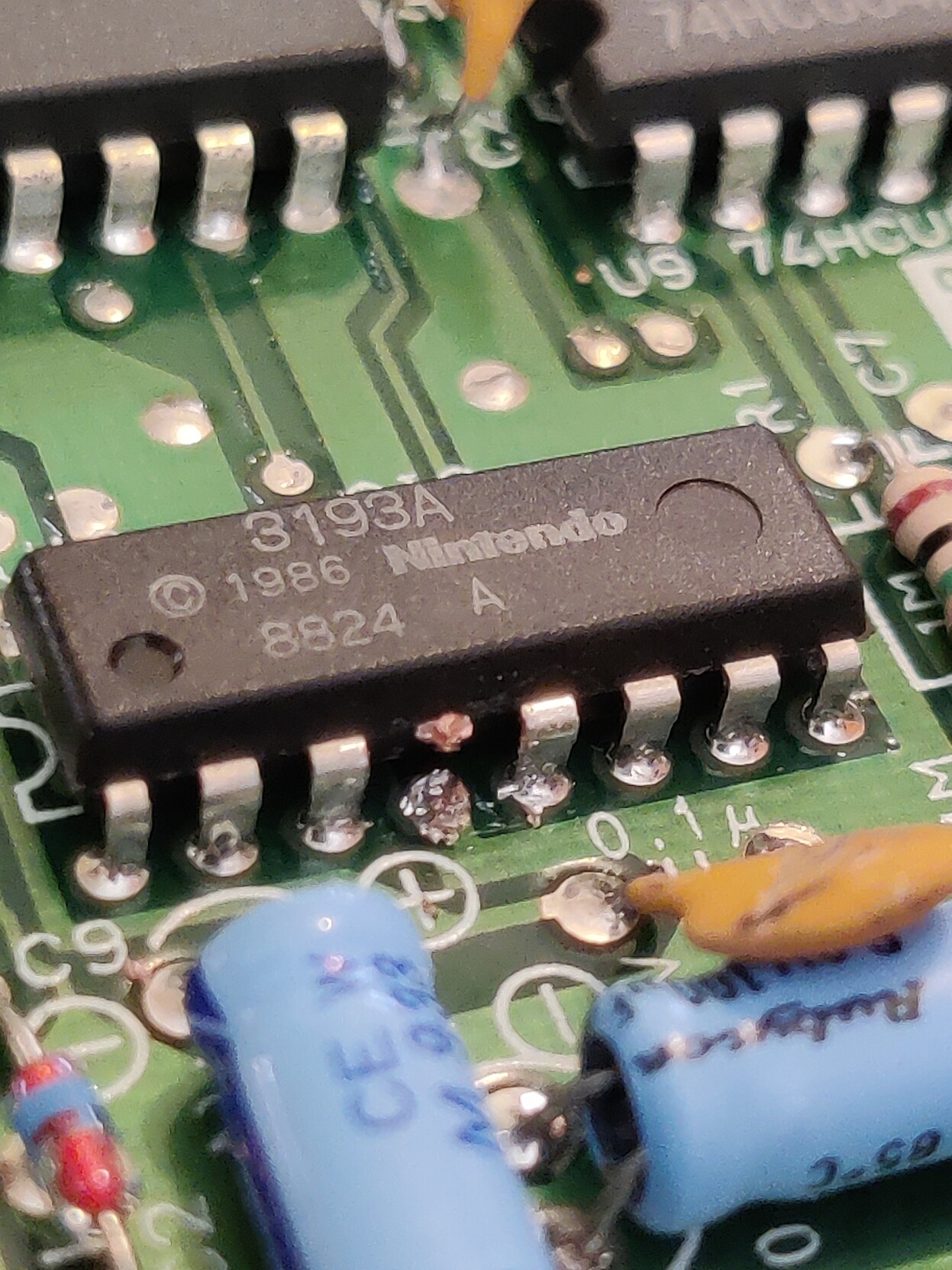
@typhlosion @rey Looks like you've done the job there honestly! it's very hard to damage the chip inside by doing anything to the pins on the outside
-F
@typhlosion @rey Nope! That is indeed pin 4, and the only possible knock-on effect would be if some metal fragments bridge other pins; just give it a good brushing or even a spray from a can duster to get rid of any of those
-F
@typhlosion @rey hot kassy on nes action (it's a repair video)
-F
@Felthry @rey update: when i put my Golf cartridge in, it boots to a solid yellow screen rather than doing a reset loop. which... is progress! that tells me theres something else wrong, probably with the cartridge.
when i tried Lizard before i snipped the pin, it showed the first frame of the title screen in the reset loop, which tells me that that game was probably on a good cartridge but the lockout chip was fritzing. the fact that Golf shows a solid color tells me maybe its pins are bad
@typhlosion @rey progress! try Lizard in it again maybe? That sounds like the closest thing to a known good cartridge you have
It's also possible the cartridge connector is too oxidized to make good contact; that's easy enough to clean. You can just spray contact cleaner in there and that usually helps, but you can also get these purpose-made things like this https://www.1upcard.com/products/the-1upcard-nes-console-and-game-cleaner-bundle?variant=20327843398
it's just an NES cartridge with a mild abrasive instead of electrical contacts, so it cleans off the oxide
-F
@Felthry @rey yeah, i'll try lizard in it next. that one was completely unused and hadn't even been taken out of the box before i tried it last night, so if that one isn't good it's definitely not due to usage
i did a quick visual inspection of the pin connector on the NES side when i had everything off, and it didn't look corroded (i think someone had replaced it before i got it) which is why i think it's an issue with the Golf cartridge (perhaps corrosion on *those* pins)
@typhlosion @rey yeah there could be corrosion on the cartridge pins too
if someone's replaced the cartridge connector on the NES side that doesn't necessarily mean it's good, for something like this you want pretty good gold plating on the contacts and nintendo used a pretty thin gold plating (which rubbed off over many cartridge insertions) and some of the replacements don't even use gold at all (good ones would probably be like, 30-50 μ" gold and yes that's a very cursed unit)
-F
@typhlosion @rey (it's probably fine though)
-F
@Felthry @rey success!! the music plays, all the controls work and everything. there are those wavy striations on the video output but im assuming those are just an artifact of some kind of something relating to using the NES with a modern television, or such. doesn't bother me either way
cc @rainwarrior thank you for your cool game that helped me test my NES repair job

@typhlosion @rey @rainwarrior excellent! glad it worked
i could go into what the striations are if you're interested, but you're correct that it's a consequence of using it with a modern tv
-F
@Felthry @rey @rainwarrior isn't it something to do with the video not being precisely 60Hz? i am indeed interested
@typhlosion @rey yeah i was going to do that, dunno if rey wants to be untagged too
it might be that? more likely to be artefacts of either the RF or composite output, which both lose some information in the process of modulating stuff
i'm assuming your NES hasn't been modded to have a component or s-video output here, if it has it's something else
-F
@typhlosion @rey that's not a mod, some later model NESes had that
that's composite output, where the color and intensity information are both sent over the same wire
-F
@typhlosion @rey i mean, it *could* be a mod if it's an early model NES, the kind that only had RF output, but I dunno why you'd go to the trouble of modding it and not use component or rgb
-F
@rainwarrior @typhlosion oh yeah, recapping might cut down on those lines a bit
you get those a lot more with RF or composite output too, just because those are lower bandwidth
-F
@rainwarrior @typhlosion clearly i don't know as much about the nes specifically as i'd thought!
gold plating on these types of connectors is kinda the standard, i'd be surprised if nintendo didn't use it
-F
@rainwarrior @typhlosion you definitely have to gold plate the cartridges yeah, edge connectors won't last very long if they don't have a hard gold plating
-F
@rainwarrior @typhlosion aaa now i'm feeling embarrassed, i was pretty confident in most of that but apparently we just got it from some who-knows-where unreliable source
-F
@rainwarrior @typhlosion it's just two card edge connectors connected with a ribbon cable right? should be pretty easy to make, card edge connectors are cheap (though gold plated ones obviously a little more expensive)
i suspect it's going to be a standard spacing too
-F
@rainwarrior @typhlosion oh, but you'd need to do something about the spacer
i would probably try mounting two standard connectors on a PCB, maybe? Perhaps with 3d-printed supports
-F
@rainwarrior @typhlosion oh yeah that's not far off from what i was thinking of
-F
@rainwarrior @typhlosion i am surprised at the lack of gold plating but i guess when you're an engineer who works mostly on one-off custom test equipment with a relatively large budget and no need to think about profit margin, you get used to always going for the gold plating
-F
@rainwarrior @typhlosion ah yeah at that many pins the discrepancy adds up
2.5 mm *is* a standard size, but an uncommon one; digikey doesn't have any 72-pin card edge connectors in that pitch
there are a couple companies out there that will do custom connectors, though the minimum order quantity is usually in the hundreds or thousands
-F
@rainwarrior @typhlosion Disabling the lockout is usually a good mod to do anyway, the 10NES will sometimes just start doing its reset loop even on an otherwise perfectly functional and legitimate game
-F
@typhlosion @rey outside of a few high-power packages, the only thing connecting the pin to the chip is a thin wire (gold, copper, or aluminum) that's a couple mil (1/1000 inch) in diameter. that wire can't transmit any force to the IC
-F

@rey @typhlosion could be an impetus for you to get some side cutters though! you'd certainly have more use for them outside this project than kassy, who i don't know if she plans to do much hardware work, though i don't want to put words in her mouth of course
-F