the Hearth  @Felthry@awoo.space
- Pronouns
- for Fel: It/its or they/them/themself. For Rose: Zhe/zhir or she/her.
- Gender
- your guess is as good as mine
- Timezone
- UTC-8 or UTC-7 (DST)
Bot
Plural system of three, Felthry, Alaric and Rosemary. We'll sign posts with a -F, -A, or -R.
Autistic, 20-something, anxious mess
Please introduce yourself before sending a follow request.
#FelthrysVGMSelection for my music picks.
Current avatar by @hi_cial
Joined May 2017
it is early and i'm not even an earl
note also that yes, it is *technically* possible to reverse-charge most types of batteries, even alkalines, but this is universally a failure state and they do not have much capacity when reverse charged (and will only charge to a few hundred millivolts if that)
Lead-acid cells are actually symmetric (except for mechanical asymmetries in how commercial ones are designed)
note that you should never reverse-charge them though. Modern commercial lead-acid batteries are designed to maximise performance when used in the intended operating mode, i.e. with the + terminal charged to a higher voltage than the - terminal.
did you know that lead-acid batteries can actually be charged in either polarity? it's the only battery chemistry we're aware of that allows that.
mh -/~
we have been so overwhelmed by... both everything and *nothing*, somehow, that thinking is hard x.x.x our brain can't brain right now
So uh. what was mixer again?
a game where the goal is to confuse snakes: Adder Addler
consider: m/n/ŋ neopronouns
they say you should walk a mile in someone else's shoes, but even @monorail's shoes are too small for that
or was it @connie who was talking about not having a DS? I forget, it was someone whose stream we watched recently x.x.x
hey @SquirrelLilly was it you who were talking about not having a DS? Apparently Walmart currently has a sale on the 2DS XL for $100, which is a really good deal. It's the last run before they discontinue the whole 3DS series (though of course used ones will still be available)
this whole github renaming master to main thing... can we do that across the rest of electrical and computer engineering?
no more MOSI and MISO, go with SDI and SDO
replace the master/slave terminology for communications and control buses with something like controller/device
oop, forgot that i'd have to accept some monsterpit follows too! Done that now
wait wait
Uematsu wrote the theme for Super Smash Bros Brawl?
that explains why it's so different
visual novels are so weird
you can pause while there's a text box up
you can *save* while there's a text box up
why can you be overwhelmed or underwhelmed but you can't be a middling amount of whelmed
the Hearth
boosted
boosted

RT @AradorTD@twitter.com
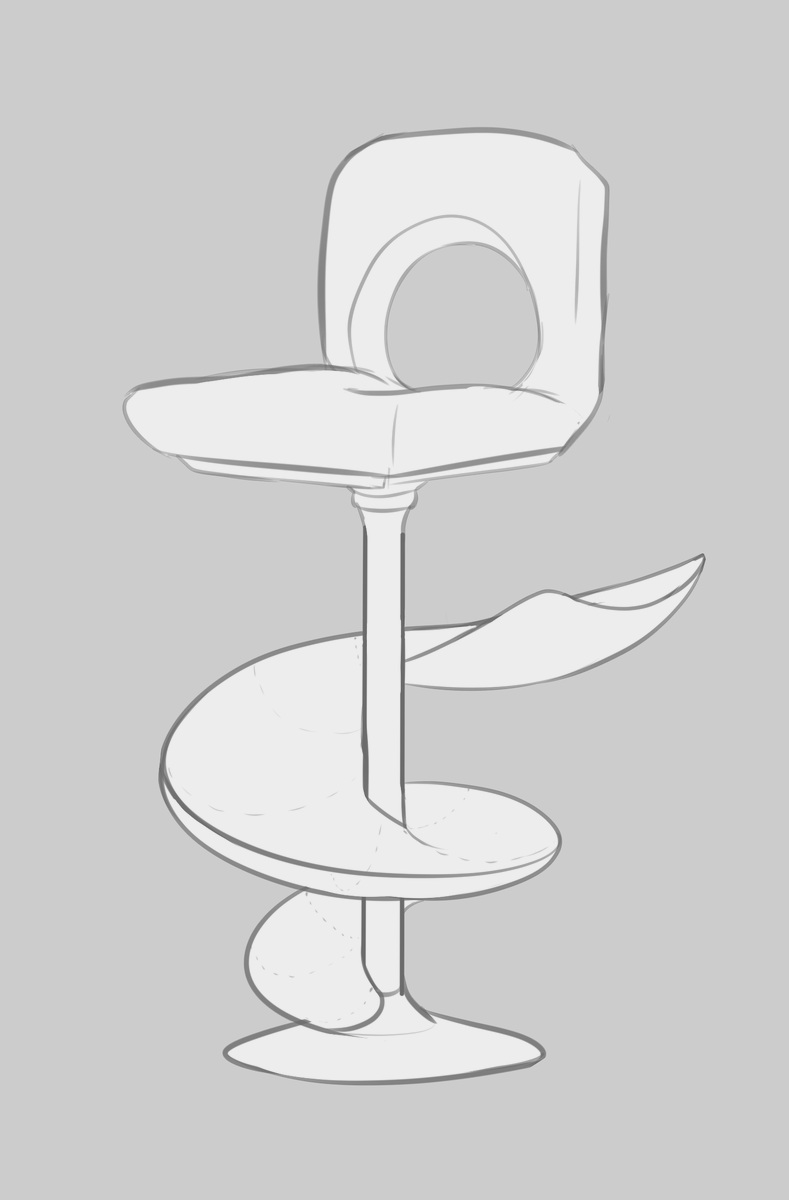
Please let me know I can order one of these chairs! <33 @ChuKazoo@twitter.com (concept by them)

longish, rambling about analog video
YPbPr is a good standard but it's a bit annoying to work with
at a hardware level stuff always tends to work in RGB. YPbPr is just a rotation of RGB, which means it's able to represent exactly the same amount of detail
the advantage of YPbPr is the same as that of composite video: if you have a black and white TV, you can still get a black and white image by just plugging in the Y (luminance) cable and ignoring the chrominance altogether.
In composite video, the chrominance is superimposed on top of the luminance, modulated at a high frequency, but in S-video, the chrominance is separated out into its own signal, and in component, it's separated into two signals for the blue and red components--the green, of course, can be determined from knowing those and the total luminance.
Since S-video has to cram two chroma components into the same bandwidth as YPbPr's single chroma component per cable, it has a slightly worse video. But both are better than composite, which crams both chroma components into a very tiny bandwidth, since you always want as much bandwidth as you can spare going to your luminance.
Component gets around the whole thing by giving the full bandwidth to all three and using three communication channels, which is the ideal situation and allows for your chrominance to be equal in resolution to luminance.
specifically, we got an SNES SCART cable wired up for a north american SNES's RGB output (you can only get these aftermarket for obvious reasons--nothing in north america uses SCART) along with an RGB->YPbPr transcoder
this is needed because the SNES natively supports only composite video, S-video, and RGB, and composite video has chroma bleed, our tv doesn't support S-video (and it also has smaller amounts of artifacting), and our TV doesn't support RGB (nor do most TVs)
- Pronouns
- for Fel: It/its or they/them/themself. For Rose: Zhe/zhir or she/her.
- Gender
- your guess is as good as mine
- Timezone
- UTC-8 or UTC-7 (DST)
Bot
Plural system of three, Felthry, Alaric and Rosemary. We'll sign posts with a -F, -A, or -R.
Autistic, 20-something, anxious mess
Please introduce yourself before sending a follow request.
#FelthrysVGMSelection for my music picks.
Current avatar by @hi_cial
Joined May 2017